

Ravencoin Drops 19% After Network Split Due to Consensus Error
On August 11, 2026, Ravencoin revealed that a serious consensus vulnerability had been exploited since August 7, allowing compromised nodes to accept invalid blocks starting at height 4,487,776.
Summary
- Ravencoin reported that invalid blocks began at height 4,487,776 due to a critical consensus vulnerability.
- 2Miners released an emergency patch to reject forged blocks and recommended that network operators upgrade their systems.
- Transactions confirmed after block 4,487,775 could be at risk if a recovery chain gains dominance.
- Upbit suspended RVN deposits and withdrawals because of a network issue affecting Ravencoin.
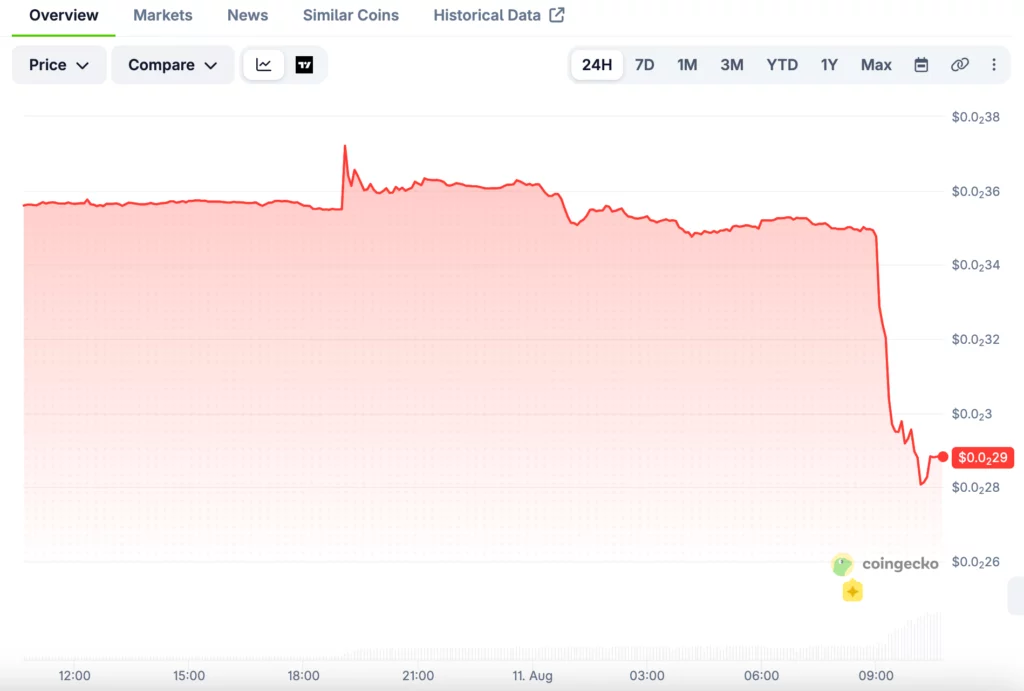
- As a result of the security concern, RVN fell by 19.1% to around $0.00288 on Tuesday.
The project alerted that if both 2Miners and RavenMiner continue mining a recovery chain, it could potentially lead to a significant reorganization lasting “approximately three days” if it becomes dominant.
This warning followed an emergency software update from 2Miners on August 10. The pool mentioned that the vulnerability was related to KAWPOW block header validation, which enabled an attacker to bypass the usual memory-intensive mining processes. Ravencoin advised exchanges to halt RVN deposits and withdrawals and cautioned users to regard confirmations after block 4,487,775 as possibly reversible.
Ravencoin bug permitted cheap invalid blocks
2Miners clarified that the KAWPOW header contains an nHeight field that isn’t validated against a block’s actual position in the chain. By modifying this value, an attacker could take a validation path that circumvented full proof of work verification and accepted a fabricated mix hash without confirming genuine ProgPoW work.
The emergency release highlighted that blocks created through this flaw had no authentic ProgPoW work and were “orders of magnitude cheaper” to create compared to valid blocks at an equivalent difficulty. It also observed two issues on the mainnet: affected nodes could crash upon restart, and nodes attempting to sync might encounter broken header sequences and fail to catch up.
2Miners reported that the exploitation occurred from August 7 until the release on August 10. It identified 96 compromised blocks among 2,089 surveyed between heights 4,489,527 and 4,491,615. A separate sample from before August 7 showed no affected blocks, emphasizing the identified onset of the issue.
2Miners deploys emergency patch as recovery efforts continue
2Miners launched version 4.6.1.1-hf1, designed to reject blocks if their declared header height differs from their actual position in the chain, starting from 4,487,776. The patch also sets a checkpoint at 4,487,775 and reconstructs chain state if damaged index data disrupts a node’s regular operation.
The pool urged node operators, exchanges, miners, and explorers to implement the update. Its release noted that the initial restart could take several hours, as the software replays around 4.49 million blocks and 28 million transactions while rebuilding chain state. Operators handling multiple nodes were advised to upgrade them one by one.
Ravencoin’s official GitHub indicated that a core version addressing both the KAWPOW issue and a distinct asset transfer quantity overflow bug has not yet been released. Maintainer Hans Schmidt recommended using the 2Miners code for the mining issue until a complete patch is available.
Exchanges halt transactions as RVN declines 19%
Upbit suspended Ravencoin deposits and withdrawals on August 10, citing a network issue, before the project’s full announcement. Their notice confirmed that trading could continue while transfers were halted. Bitget also paused RVN deposits and withdrawals for wallet maintenance starting August 10.
According to CoinGecko data, RVN was trading around $0.00288 on Tuesday, reflecting a 19.1% decline over the previous 24 hours. Its market capitalization fell to approximately $47.3 million, with a 24-hour trading volume nearing $11 million.
Earlier, Ravencoin encountered a different protocol vulnerability in 2020, where attackers exploited flaws to generate around 315 million unauthorized RVN. This previous incident involved excessive token creation, while the current vulnerability deals with proof of work validation and conflicting chain histories.
In related block reorganization news, an 18-block Monero reorg in 2025 led to previously confirmed transactions being invalidated. This scenario underscores why exchanges adopt caution regarding transaction finality when proof of work networks contend with overlapping histories.
What lies ahead for the Ravencoin chain
Ravencoin indicated that 2Miners and RavenMiner currently control the majority of the network hash rate and are mining from the last unaffected block while excluding the compromised branch. The project warned that if their chain takes precedence, transactions confirmed after 4,487,775 may vanish from the accepted history. Some may revert to mempools and be mined anew, although Ravencoin noted this is “not guaranteed.”
Future objectives include establishing a stable dominant chain, wider adoption of the patched software, and a consolidated upstream Ravencoin release. Until those goals are met, the project advises exchanges to suspend transfers and users to avoid relying on recent confirmations. Ravencoin also stressed that its alert should not be interpreted as an endorsement for a rollback or any specific recovery plan.