

Coinbase and Ripple Scheduled to Attend White House Cryptocurrency Meeting on August 19th
Executives from Coinbase and Ripple are set to attend a White House meeting on August 19, which will involve at least six companies from the crypto and prediction market sectors.
Summary
- Representatives from six crypto and prediction market companies are anticipated to attend the White House meeting.
- Participants reportedly include Coinbase, Ripple, a16z, Chainlink, Paradigm, and Kalshi.
- The CLARITY Act is due for a procedural vote in the Senate on September 15, requiring a minimum of 60 votes.
- The CFTC will hold a meeting the following day to address topics related to crypto, AI, and prediction markets.
According to Semafor reporter Eleanor Mueller, Coinbase, Ripple, a16z, Chainlink, Paradigm, and Kalshi executives are likely to be in attendance, based on insider knowledge.
While the report did not specify which executives would represent their respective firms, both Coinbase’s CEO, Brian Armstrong, and Ripple’s CEO, Brad Garlinghouse, have openly supported the Digital Asset Market Clarity Act. This legislation is currently stalled in the Senate due to lawmakers’ recess in August.
The initial report suggested that President Donald Trump might participate alongside members of his administration. However, a previous report from crypto.news indicated that no formal participant list had been made public, leaving Trump’s attendance uncertain.
Additionally, CFTC Chairman Michael Selig and SEC Chairman Paul Atkins are expected to be part of the meeting, but as of the time of writing, neither the White House nor the regulators had released a formal agenda.
Coinbase and Ripple’s Interests in the CLARITY Act
This meeting is crucial for Coinbase and Ripple, coming right before a Senate test for legislation that might delineate the responsibilities of the two primary U.S. market regulators concerning digital assets.
The CLARITY Act aims to place spot markets for qualifying digital commodities under the oversight of the CFTC while keeping crypto assets classified as securities under the SEC’s jurisdiction. Furthermore, it would impose federal requirements for exchanges, brokers, dealers, advisors, and custodians of digital assets.
American investors could be significantly affected by this regulatory division, as a token’s status can influence where it is traded, the applicable disclosures, and whether a platform must register with the SEC or adhere to CFTC regulations.
Coinbase has shown support for the legislation but has expressed concerns regarding portions related to stablecoin rewards and decentralized finance. In a statement on August 7, Armstrong expressed disappointment over the Senate’s delays but asserted that adoption would proceed regardless of Congressional timing.
“The momentum supporting this technology continues to build with or without a congressional calendar,” Armstrong stated.
An August 8 article highlighted Armstrong’s focus on stablecoin use, tokenized assets, and perpetual futures as areas poised for growth while lawmakers are in negotiation. He also emphasized that a consistent federal framework could foster investment and enhance protections for U.S. consumers.
Garlinghouse has also advocated for the bill during negotiations. Both Ripple and Coinbase were part of a coalition exceeding 120 companies that urged lawmakers to press forward with the proposal in April, as noted in a report from May on Garlinghouse.
Andreessen Horowitz, commonly referred to as a16z, has likewise backed the legislation, while Chainlink collaborates with financial institutions on blockchain infrastructure. Paradigm, which invests in crypto enterprises, is a supporter of Kalshi, a CFTC-regulated prediction market operator.
CLARITY Act’s September 15 Senate Test
Senate Majority Leader John Thune initiated cloture on the motion to move forward with the CLARITY Act before the Senate’s August recess. The Senate Daily Press schedule indicates that the motion will mature at 2:15 p.m. on September 15, the day after senators reconvene for regular business.
The procedural vote will not directly pass the bill or forward it to Trump. If cloture is achieved, the Senate will start formal deliberations on the bill, allowing lawmakers to debate the proposal, suggest amendments, and hold a separate vote on the final version.
A minimum of 60 senators must support cloture. Since Republicans alone cannot reach this threshold, Democratic votes will be essential even if a majority of Republican senators back the legislation.
The House approved its version in July 2025, with a 294–134 vote, comprising support from 78 Democrats alongside Republicans. In May 2026, the Senate Banking Committee advanced its portion of the legislation with a vote of 15–9, thanks to some Democratic Senators voting alongside Republicans.
Any Senate-approved text differing from the House measure will necessitate either another House vote or negotiations between the two chambers before it can reach the president.
Outstanding disagreements include issues surrounding political ethics provisions, rules governing rewards on stablecoin balances, protections for software developers, controls against illicit finance, and consumer safeguards. The White House has not confirmed whether these topics will be part of the agenda for the August 19 meeting.
Prediction Markets Skeptical About Passage
Prediction markets currently indicate a low probability for the CLARITY Act’s success in 2026, even as the Senate prepares for its procedural vote in September.
As reported, Polymarket traders assigned a 19% likelihood to the Act’s passage. This figure fluctuates as trading participants react to news about the White House meeting and the Senate timeline.
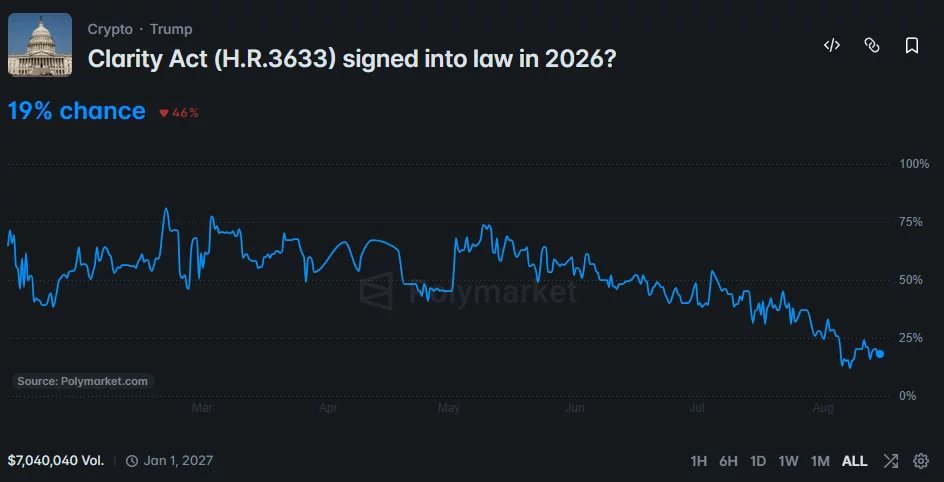
On August 14, the contract briefly indicated a 21% probability, up from 17% the day before. A more recent assessment showed the chance at 16%, a decline from a peak of 82% in February.
Galaxy Research reportedly estimated a 10% chance for passage in 2026, attributing the low probability to unresolved policy issues and a limited number of Senate working days leading up to the midterm election recess.
A different Kalshi contract indicated a more favorable perception regarding an earlier procedural event. As of August 11, traders assigned an 88% chance that the Senate would vote on the legislation prior to October 1, with around $1.23 million traded on that contract. This date aligns with Thune’s September 15 cloture timeline but does not necessarily predict approval from the senators.
Following CFTC Meeting on August 20
Insiders have framed the White House event as a precursor to the first meeting of the CFTC Innovation Advisory Committee, slated for August 20 in Washington, D.C.
The CFTC’s stated agenda reveals that the three-hour meeting is set to occur from 1 p.m. to 4 p.m. Eastern Time. Committee members will attend in person, while the public can observe the proceedings online.
The opening 50-minute panel will delve into the history of crypto regulations, state licensing requirements, overlapping jurisdictions, and the absence of a comprehensive federal market structure framework. Members will also discuss how the CFTC can modernize current regulations within its existing legal framework and support forthcoming Congressional legislation.
A subsequent panel will focus on artificial intelligence in trading, compliance, market surveillance, and risk management, highlighting autonomous systems capable of executing transactions or managing portfolios.
The concluding session will investigate topics related to prediction markets, event contracts, market surveillance, manipulation risks, and customer protections. The agenda also raises questions concerning federal and state authority, an issue pertinent to Kalshi and other regulated event-contract platforms.
It’s important to note that the advisory committee will not vote on any proposed crypto rules, and its recommendations do not automatically become CFTC policy. Members of the public are allowed to submit written remarks about the meeting until August 27, with relevant submissions becoming part of the public record.
In a related note, the SEC has canceled an open meeting originally planned for August 14, during which a proposed offering framework for specific crypto-related investment contracts was to be discussed. The agency has not provided a reason for the cancellation or announced a new date for the meeting.