

Cryptocurrency transitions to Wall Street era while retail enthusiasm decreases and liquidity shrinks
Gracy Chen has aspirations beyond merely operating a cryptocurrency exchange.
The CEO of Bitget – currently ranked as the sixth-largest exchange by trading volume according to CoinMarketCap – notes that institutional clients are increasingly interested in trading a blend of stocks, commodities, and cryptocurrencies, utilizing equities for collateral and consolidating their assets on a unified platform.
Additionally, there’s a more pressing motivation for her desire to expand beyond digital tokens: she believes the traditional crypto trading landscape is deteriorating.
“Liquidity has not returned for nearly a year, and I don’t foresee its return,” Chen stated from Hong Kong. “This is why we aim to be more than just a crypto exchange. Competing solely with Binance isn’t enough for us – we also view Robinhood as a competitor.”
Read: Crypto critic Nouriel Roubini finds a use for the blockchain
The inconsistency is becoming increasingly evident: While crypto is witnessing its most significant institutional acceptance to date, the core crypto market is moving in the opposite direction. Financial institutions are integrating assets and products onto blockchains, institutional trading desks are increasing their influence, and regulatory obstacles have lessened.
Despite this, three crypto exchanges, including BitMEX, ceased operations this summer. Chen highlights a sharp decline in liquidity for altcoins, drawing parallels to the downturn of 2022.
“This is the reality we’re facing. In 2026, it feels reminiscent of 2022,” Chen remarked, referencing the year when several crypto lenders and the FTX exchange imploded. “I suspect the worst phase of 2026 hasn’t arrived yet. It might get even tougher.”
Challenging the Wall Street crypto thesis
ADVERTISEMENT
CONTINUE READING BELOW
This raises questions about a key assumption underpinning crypto’s anticipated institutional era: that the entry of Wall Street into digital assets would automatically lead to an increase in money and liquidity flowing throughout the market.
Instead, it appears institutions may be catalyzing a new type of crypto market, one that is more concentrated on fewer assets and increasingly centered around payments, collateral, and real-world assets (RWAs) linked to blockchain rather than the widespread speculation that fueled past surges.
Read: New cryptocurrency exchange aims to convert vineyards into investment opportunities
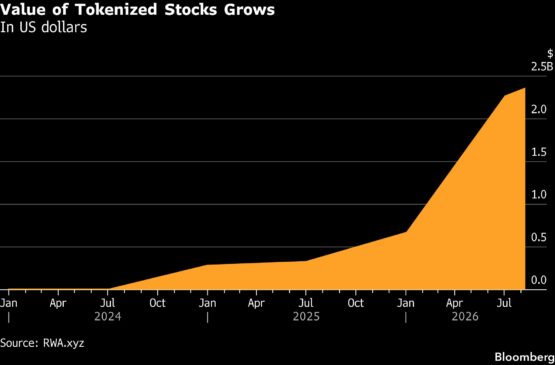
“We believe RWAs will surpass traditional crypto assets [onchain] in the next three years; that’s the direction I see the space heading,” stated Stani Kulechov, founder of the lending marketplace Aave, which introduced an institutional-focused offering about a year ago.
“We’re observing tokenized stocks transitioning on-chain, which will likely drive more traffic into crypto. However, the majority of this interest will gravitate toward tokenized stocks rather than crypto assets.”
Institutions mitigate Bitcoin volatility
Market maker Wintermute’s trading data suggests a trend: institutional counterparties represented 72% of its spot over-the-counter flow during the first half of 2026, marking the highest recorded percentage.
However, the number of tokens traded by its institutional clients saw only a 24% increase between the first half of 2024 and the first half of 2026, in contrast to a 76% rise among retail clients.
“Institutions are far more selective,” noted Jasper De Maere, an OTC trader at Wintermute, pointing out that institutional interest tends to focus on a handful of coins like HYPE, associated with the well-known derivatives exchange, which provide access to technological advancements.
“This time, a rising tide won’t lift all boats, as we observed in previous cycles. Only a few coins will excel, while many will lag significantly behind.”
ADVERTISEMENT:
CONTINUE READING BELOW
Read: Bitcoin’s $235bn plunge hides a more significant shift in crypto
The involvement of institutions tends to stabilize the market: Bitcoin’s one-year annualized volatility has decreased to 42% in early August, down from 48% a year prior and 69% during 2022, according to data from Glassnode.
As retail traders have increasingly sought out high-volatility assets, hoping for rapid gains, many have shifted to hotter markets such as artificial intelligence and prediction markets.
Institutions exhibit “considerably more capital discipline,” according to De Maere. “They pursue trends for much shorter durations.”
Banks intensify crypto involvement
Simultaneously, some of the largest banks globally are advancing deeper into cryptocurrency infrastructure. Nick Ducoff, head of institutional growth at the Solana Foundation, noted that the number of global systemically important banks utilizing Solana has increased to seven from just two or three a year ago, covering areas like trade finance, funds, and custody.
Continued favorable regulations in the U.S. during Donald Trump’s administration, alongside the new stablecoin law—the Genius Act—implemented last year, have been significant contributors to institutional adoption, he pointed out.
“The passage of the Genius Act marks the starting point for a race,” Ducoff stated.
The two trends are not mutually exclusive. They indicate that institutional adoption is increasingly separating from the fortunes of the overall retail crypto market.
ADVERTISEMENT:
CONTINUE READING BELOW
Read: Absa’s daring venture into stablecoins
Wall Street may discover additional applications for blockchains, stablecoins, and select digital assets, even as liquidity wanes in other areas of crypto. For instance, JPMorgan Chase leverages the Ethereum blockchain for tokenized deposits, enabling clients to swiftly exchange funds or provide collateral.
State Street Investment Management, in partnership with others, offers a tokenized private liquidity fund designed for 24/7 on-chain cash management via stablecoin on Solana.
The industry may finally be witnessing the institutional adoption it has long sought, albeit not the sweeping crypto boom that was anticipated. Bitcoin is currently trading at about half of its all-time high from October.
Read: The crypto revolution lies in real-world asset tokenization
“The critical question that will shape the future is whether retail will come back,” said De Maere.
In the interim, most crypto platforms, including Bitget, are executing their “everything exchange” strategies by offering a wide range of assets, from stocks to commodities. Chen reported that around 20% of Bitget’s average daily volume now stems from non-crypto assets, a notable increase from none just a year ago.
© 2026 Bloomberg