

Shein Sees 1% Revenue Growth in First Financial Results Since IPO
Shein Global Holdings announced a 1% increase in net revenue for the first half of 2026, marking its first results as a publicly traded company. The online fashion retailer is facing challenges with decreasing demand and higher costs.
On September 1, Shein made its trading debut in Hong Kong, and in an exchange filing on Monday, it reported that operating income plunged 52.9% compared to the first half of 2025, continuing the trend of declining profitability observed in the first quarter of the year.
In its IPO filing, Shein had already indicated that the conflict in Iran would negatively impact its first-half performance. It projected that revenue growth would roughly align with the 1.1% recorded in the first quarter, albeit with a slightly reduced operating margin.
This report comes shortly after Shein’s public debut, which concluded a prolonged and often delayed journey to the market. The company’s current valuation of approximately $26 billion is significantly lower than the nearly $100 billion it was valued at its peak in 2022.
“We anticipate the external environment will remain unpredictable in the latter half of 2026, with continuing tariff challenges and fluctuating logistics costs,” the company stated in its interim report. “Nevertheless, the fourth quarter—featuring events like 11.11, Black Friday, Cyber Monday, and the Christmas season—represents our most crucial promotional period and should lead to a considerable increase in orders.”
Shein’s revenue growth and profitability have declined compared to last year, putting pressure on executives to reassure investors as the stock trades nearly 27% below its initial listing price. The retailer is contending with slowing demand, rising expenses, and increasing regulatory scrutiny.
Growth Challenges
Early indicators suggest a continuation of weakened performance in the third quarter. Data from third parties, interviews with key suppliers, and analyst forecasts indicate that conditions have continued to worsen during this period, highlighted by softer sales in the U.S. and a decrease in global web traffic. This situation intensifies the urgency for Shein to accelerate the expansion of its new ventures to compensate for downturns in its core ultra-fast fashion business.
ADVERTISEMENT
CONTINUE READING BELOW
“Unless there is a clear strategy to tackle short-term growth issues, reversing the long-term downtrend will be difficult,” said Shen Meng, director at the Beijing-based investment bank Chanson & Co.
Further signs of third-quarter weakness will heighten investor apprehension regarding Shein’s long-term growth outlook, according to Shen.
According to Bloomberg Second Measure, which tracks credit and debit card transactions, Shein’s U.S. sales dropped more than 10% in the three-month period leading up to August and early September, a sharper decline compared to the single-digit drop in the broader specialty online retail sector.
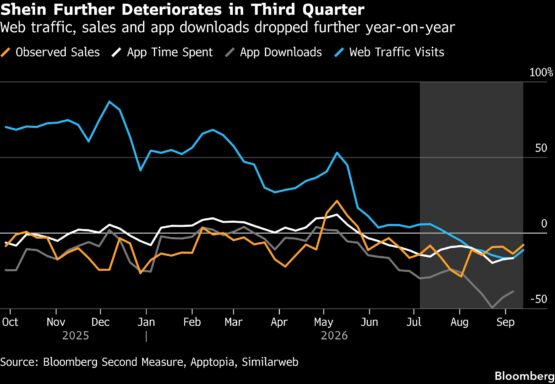
Since late last year, Shein’s sales have lagged behind the broader apparel industry in the U.S., whereas competitors like PDD Holdings Inc.’s Temu and Amazon.com Inc. have experienced single- to double-digit growth since April.
Two primary suppliers from China informed Bloomberg that their orders from Shein have decreased by around 20% in the third quarter, with declines worsening in August and September, according to these suppliers who preferred to remain anonymous.
Shein has not yet provided a comment regarding these developments.
Other indicators point to challenges in both attracting and retaining customers. Global web traffic to Shein fell year-over-year in August, marking its first decline since late 2024, according to Similarweb.
ADVERTISEMENT:
CONTINUE READING BELOW
Additionally, the time spent on Shein’s platform declined by over 10% in July and August, while app downloads plummeted more than 40% in August, as per Apptopia.
Some of this weakness may be indicative of a broader downturn in e-commerce. The two suppliers reported a similar deterioration in business with Temu, whose global web traffic has diminished since March. The time spent on both Temu and Amazon also saw a decline over the summer. Temu has not yet responded to requests for comment.
Regulatory changes and cost pressures exacerbate Shein’s hurdles. France implemented new fees on ultra-fast fashion items on September 1, while the European Union, a major market, ended its de minimis customs duty exemption in July.
Bloomberg Intelligence analysts Catherine Lim and Jason Zhu project that Shein’s revenue growth will slow to approximately 2.5% in 2026, with adjusted operating profit decreasing by more than 19% due to rising oil and shipping costs tied to the conflict in Iran affecting margins.
Ultimately, the key question remains whether this decline will persist. According to Lim and Zhu, third-quarter sales will serve as “the key test.”
© 2026 Bloomberg