

Nvidia Targets $6 Trillion Valuation with Record High Chipmaker Performance
Nvidia is on the brink of becoming the first firm to achieve a $6 trillion market capitalisation as investors shift their focus back to the AI chipmaker.
The stock has hit a new all-time high following the company’s strong revenue forecast and the announcement of the largest stock buyback in history, capitalising on a valuation that is near multi-year lows. These two factors — solid growth and an appealing valuation — are particularly prominent, especially as investors navigate high interest rates and weak economic indicators.
“Nvidia is appealing both for its growth potential and its value proposition, appearing as a refuge from the potential harm higher rates could inflict on the economy,” stated Jim Awad, senior managing director at Clearstead Advisors, which is an Nvidia shareholder. “This makes it an attractive option for those concerned about the current economic landscape.”
The stock has surged 28% this year, contributing an additional $1.2 trillion to Nvidia’s market capitalisation, which now stands just under $5.8 trillion. The company is also the largest contributor to the S&P 500 Index’s 14% increase in 2026.
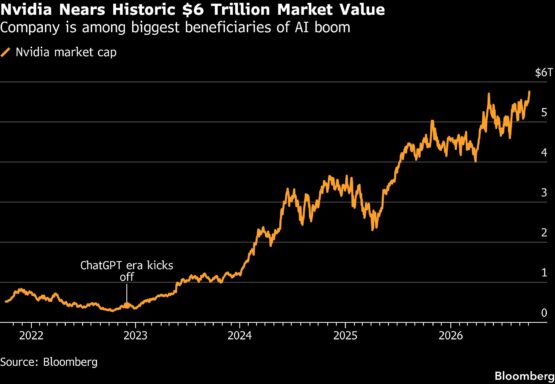
This turnaround is particularly notable considering the stock was down by 11% earlier this year on March 30, as investors questioned the hundreds of billions being invested in AI infrastructure. Since then, sentiment regarding the AI sector has shifted, with critical discussions surrounding its potential threats to humanity now dominating the dialogue. Meanwhile, inflation concerns and the inevitability of interest rate increases from the Federal Reserve have made large tech firms like Nvidia appear relatively stable to investors.
“As concerns about rate hikes have materialised, capital has started flowing into these megacap tech stocks because they’re somewhat more resilient in the face of such changes,” noted Larry Tentarelli of Blue Chip Daily, adding that the semiconductor sector has also rebounded significantly, boosted by Meta Platforms Inc.’s Muse AI initiative. There’s been a “major shift back into semiconductors, a significant rotation into the megacaps, and both trends are beneficial for Nvidia.”
ADVERTISEMENT
CONTINUE READING BELOW
The appeal for investors was further highlighted by Nvidia’s decision to authorise an additional $150 billion for its ongoing share repurchase program, which CEO Jensen Huang stated “reflects our confidence in the long-term prospects ahead.” He previously referred to Nvidia as “the world’s first and only growth value stock.”
Wall Street typically favors buybacks as they represent returns to shareholders and reduce the number of outstanding shares, consequently boosting earnings per share. Nvidia’s repurchase approach stands out among Big Tech firms that predominantly allocate their cash for AI investments, with Apple Inc. being a notable exception.
The buyback “is what investors are eager to see,” as it demonstrates the company “sharing its substantial profit margins with shareholders,” wrote Mizuho Securities analyst Jordan Klein in a note to clients on Sept. 28.
While some argue that buybacks simply inflate earnings per share without facilitating organic growth, this doesn’t apply to Nvidia. In its last report, the chipmaker forecasted sales growth of 70% in fiscal 2028, significantly exceeding the previously anticipated growth of 45%.
“The ability to execute such a substantial buyback is indicative of its rapid growth, resulting in excessive capital,” Clearstead’s Awad said. “Nvidia remains at the forefront of an AI revolution that shows no signs of slowing down, and the demand it is experiencing appears largely unaffected by rising rates, which bolsters confidence in its sustainability.”
Nvidia’s net income is projected to double in fiscal 2027, which concludes in January, with revenues expected to jump by 90%. This marks an increase of 65% for both metrics from the previous year.
ADVERTISEMENT:
CONTINUE READING BELOW
Despite these achievements, Nvidia is still trailing behind the broader semiconductor sector this year. The Philadelphia Stock Exchange Semiconductor Index has surged by 86% in 2026, propelled by companies such as Micron Technology, Marvell Technology, and Intel Corp, whose share prices have more than doubled, even as they trade below the record highs attained earlier this year.
Part of Nvidia’s challenge stems from the market’s physics — it is now the largest stock globally, necessitating significant movements to shift shares that have consistently outperformed in the S&P 500 over the last decade. Can this growth continue indefinitely?
This question is central to why the stock is currently trading at about 17 times projected earnings for the next 12 months, approaching its lowest point in 10 years and trading at a discount to the S&P 500 Index, which stands at 19 times forward earnings.
“Nvidia is a bargain, but the challenge it faces is that it’s almost a casualty of its own success,” Tentarelli remarked. “It requires substantial activity to shift the stock’s trajectory.”
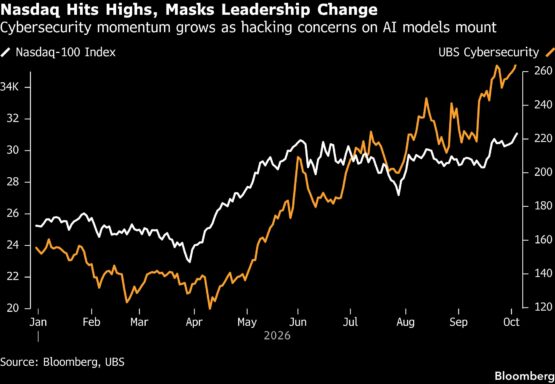
Tech chart of the day
© 2026 Bloomberg