

Floods and Storms Offer Industrial Sector €500 Billion Potential Opportunity
The increasing incidence of heat waves, wildfires, and floods in Europe is pushing governments to boost investment in climate-resilient infrastructure, thereby creating a lucrative opportunity for industrial companies.
Companies that manufacture industrial equipment, such as Schneider Electric SE, ABB Ltd, and Siemens AG, are poised to gain from the urgent need to fortify buildings and power grids against more severe weather conditions.
According to Bloomberg Intelligence, government investments in the EU and UK aimed at enhancing infrastructure resilience are projected to reach around €500 billion ($561 billion) over the next ten years.
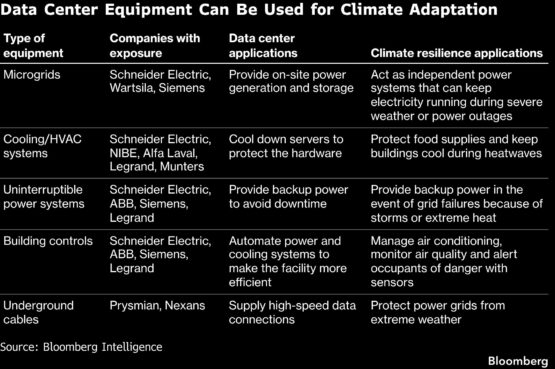
The rising demand for cooling and electrical grid equipment can be attributed to the recent surge in data-centre construction. Climate adaptation is anticipated to serve as another growth factor, targeting technologies similar to those being used in data centres, including electrical resilience, grid upgrades, and systems for optimizing building energy usage.
Read: Heat transforms into a significant economic challenge for an unready Europe
“Industrials have performed exceptionally due to AI-related demand, and there are whispers regarding whether that enthusiasm is slightly waning,” said Grace Osborne, a BI analyst, in an interview. “Climate adaptation adds an additional layer of demand.”
Schneider Electric has increased its profit forecast following a wave of AI-induced demand for its data-centre equipment. European counterparts ABB and Siemens have similarly reaped benefits from this surge.
“Whenever there are concerns regarding a slowdown in data-centre construction, these companies tend to see significant sell-offs,” stated Matthew Donen, an analyst at Morningstar. “However, much of the equipment can be repurposed for various infrastructure projects.”
ADVERTISEMENT
CONTINUE READING BELOW
This summer served as a “wake-up call” regarding heat, with energy security concerns escalating since Russia’s invasion of Ukraine, according to Citi analyst Martin Wilkie.
“The combination of structurally higher energy prices and heat-related health issues—whether in homes, hospitals, schools, or care facilities—has prompted a realization that action is necessary,” he noted.
The opportunities extend across both buildings and electric grids. Upgrades in Europe’s buildings have primarily aimed at reducing emissions, but the rising temperatures are now driving demand for cooling, ventilation, and automated control systems.
This could benefit companies like Alfa Laval AB and Munters Group AB, whose cooling technologies are already capitalizing on the data-centre boom, as indicated by BI research.
Increasing wildfires and flooding are also intensifying the need to reinforce aging electricity networks against severe weather conditions.
The demands from AI-driven data centres and the overall electrification of buildings, transportation, and industry represent distinct power consumption sources, but both necessitate investment in the same electricity grids.
Read: Major tech firms entangled in Europe’s energy politics
“Many of the technologies utilized by Schneider, ABB, and Siemens are similar,” Wilkie explained. “They are providing breakers, transformers, and control software that optimize power management, whether in a data centre, on the grid, or in an industrial setting.”
In July, Schneider Electric acquired risk intelligence provider AiDash for $350 million, enhancing its smart-grid offerings with wildfire and storm-risk management capabilities. The company also took a significant step in AI by agreeing to buy industrial software firm PTC for approximately $22.6 billion, strengthening its AI capabilities.
ADVERTISEMENT:
CONTINUE READING BELOW
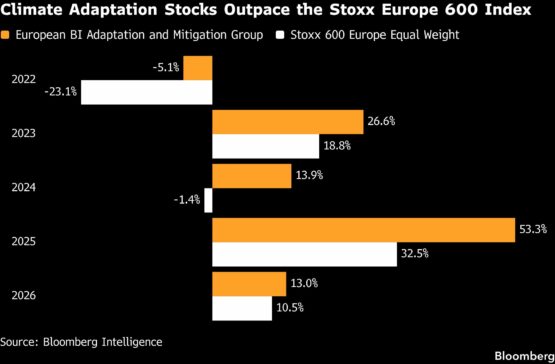
According to BI research, 64 European companies positioned to benefit from rising climate-related expenses—such as Siemens, ABB, and Munters—outperformed the equal-weight Stoxx Europe 600 Index by 13 percentage points annually over the past five years, and by 2.5 percentage points through August.
The EU estimates it will require around €70 billion annually for climate-adaptation investments until 2050 to mitigate growing risks, transitioning spending from disaster response to proactive damage prevention.
This shift is already evident in significant contracts. Italy’s Prysmian SpA secured a €910 million contract for Greek-island interconnections involving submarine and land-based cables, while France’s Enedis was awarded a €550 million contract to upgrade the country’s power grid.
Private investment is anticipated to play a larger role in climate adaptation alongside public funding, with the challenge being the rapid deployment of these funds.
According to BI, the EU’s Cohesion Fund, designed to assist climate adaptation projects in specific member states, had a budget of €17.8 billion for 2021 to 2026, yet only €2.5 billion has been utilized to date, with the remainder expected to be released between 2027 and 2029.
“The speed at which that capital is allocated presents a challenge,” Osborne from BI remarked.
© 2026 Bloomberg