

Economists Caution of Slower Growth and Stagflation Ahead: Be Prepared
The 43 economists from both the private and public sectors participating in this year’s BMR/Unisa Economist of the Year Competition do not anticipate a rate increase for the rest of 2026.
These economists provide monthly forecasts on essential annual or fourth-quarter economic indicators from February to December.
Read:
‘A slightly more optimistic outlook for SA’ – Economist of the Year survey
SA’s growth outlook remains restrained – BMR
We may be transitioning into a ‘new normal’ as the world adapts to oil price fluctuations
In their recently released predictions for September, they do not foresee any further rise in the prime rate, having already accounted for the increase in late September that adjusted the prime lending rate to 10.75.
Professor Carel van Aardt, chief operating officer of the Bureau of Market Research (BMR), shares a similar view, indicating it is improbable that South Africa will see another interest rate hike in 2026.
On Tuesday, October 6, the South African Reserve Bank gathered with the business sector to discuss feedback regarding the recent monetary policy hike.
During this forum, concerns emerged about sluggish growth and reduced consumer expenditure resulting from elevated interest rates, as noted by Van Aardt in a conversation with a participant.
ADVERTISEMENT
CONTINUE READING BELOW
Read:
Sarb surveys businesses to guide rate policy
More for the bank and the tank, less for everything else
“Both industry and economists have expressed worries about a potential stagflation scenario, characterized by rising inflation coupled with declining growth,” says Van Aardt.
During periods of lowered growth alongside increasing inflation, the critical question is how to manage inflation effectively.
“An increasing number of economists are realizing that due to downgraded growth expectations, demand is also lower, which will help temper inflation.”
In other words, interest rate hikes are unnecessary to control inflation since spending will naturally decline.
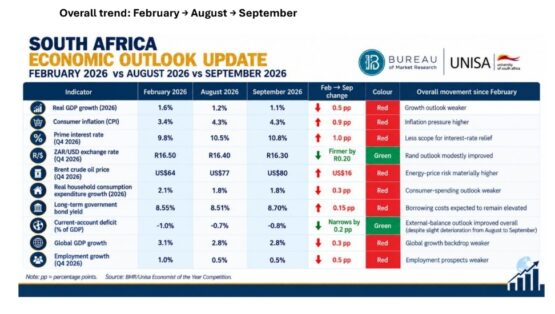
The economists’ predictions for September. Source: BMR/Unisa Economist of the Year Competition
Employment forecast
In February, the economists anticipated a 1% growth in employment throughout 2026, which remains insufficient to significantly reduce unemployment.
ADVERTISEMENT:
CONTINUE READING BELOW
By September, the forecast for employment growth had been revised down to 0.5%.
Van Aardt states, “that’s a projection that genuinely concerns me.”
“The implication of this is a trend towards non-inclusive growth.”
“With jobs not being created at a sufficient rate, this will likely result in slower salary/wage growth, which in turn will impede growth in household consumption expenditure.”
This slowdown will further limit consumer spending, which is critical since approximately two-thirds of South Africa’s GDP is tied to household consumption expenditure.
Things could be worse
On a more positive note, despite ongoing geopolitical tensions in the Middle East and surging oil prices, many of the economic forecasts for 2026 have not significantly declined since February.
ADVERTISEMENT:
CONTINUE READING BELOW
Expectations regarding inflation, household expenditure growth, and global GDP growth for the year remain consistent with August forecasts.
Economists predict a slight strengthening of the rand to R16.30 against the dollar, a marginal widening of the expected current account deficit, and an increase in long-term government bond yield expectations over the past month.
Van Aardt remarks, “even with challenges such as low growth and Trading Economics predicting Brent crude prices at $106 per barrel in the fourth quarter, we believe the impact on the economy will be manageable.”
“This is reassuring as it reflects a noteworthy resilience within the South African economy.”
Moneyweb serves as the media partner for the 2026 BMR/Unisa Economist of the Year Competition.
African Media Entertainment (AME) owns Moneyweb.