

SA Pastors Return from Israel Trip: Emphasizing the Difference Between Person-to-Person connections and Government Policies
Johannesburg – A group of 50 South African pastors and Christian leaders has returned from Israel after participating in an international event.
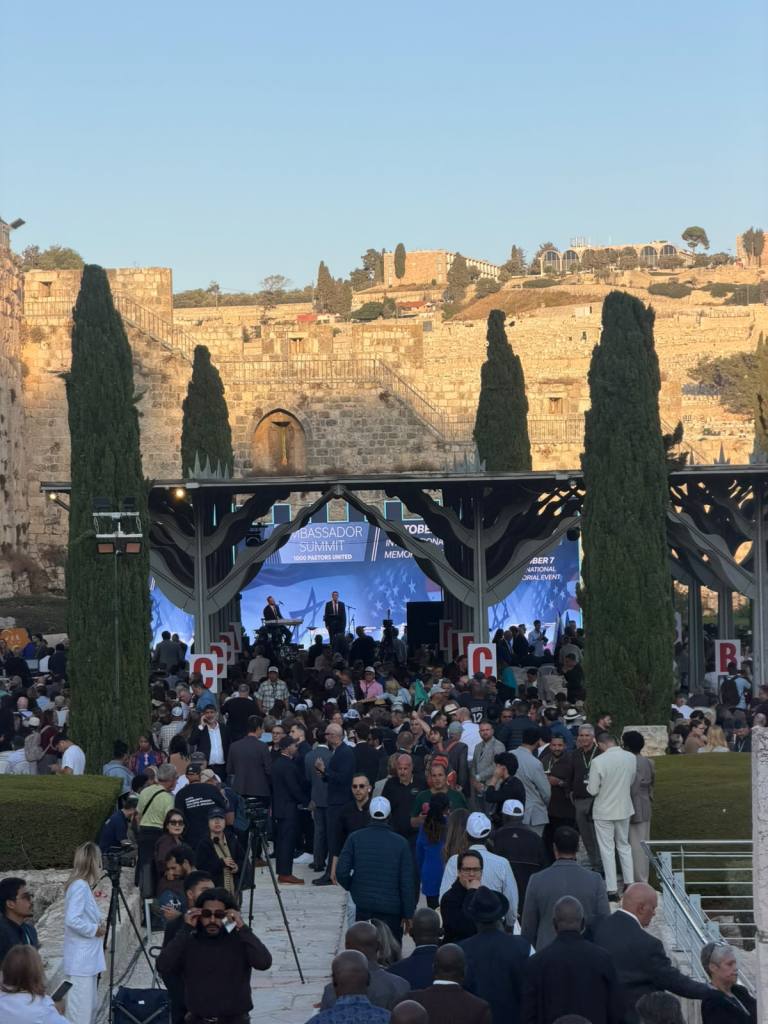
This gathering convened pastors and faith leaders from across the globe for the Ambassador Summit and Global Prayer event held in the Old City of Jerusalem on 7 October.
The chosen date marks the anniversary of the Hamas-led massacre that occurred on 7 October 2023.
The 24-hour prayer event was broadcast from Jerusalem, uniting Christians worldwide in prayer for the peace and security of Jerusalem, the people of Israel, the healing and restoration of hostages and their families, Jewish communities contending with antisemitism, wisdom for Israel’s leaders, and unity among believers globally.
This significant prayer occasion involved over 1,000 pastors from more than 100 countries, with estimates suggesting that over 40 million people watched the event live around the world.
Hosted by Dr. Mike Evans, a prominent U.S. evangelical leader and founder of the Friends of Zion and Heritage Centre and Museum in Jerusalem, the event highlighted the importance of Israel in the Christian faith.
Dr. Evans is known for saying, “For Christians, Israel is not just another country on the map. It is the cradle of our faith.”
The South African Friends of Israel (SAFI) remarked that the attendance of 50 South African Christian leaders at this event is especially significant, given the South African government’s persistent hostility towards Israel.
South Africa’s genocide case against Israel
On 29 December 2023, South Africa submitted a case against Israel to the International Court of Justice (ICJ) in The Hague, accusing Israel’s military efforts in Gaza of violating the UN Genocide Convention and constituting genocide against the Palestinian people.
Israel has denied these allegations, asserting that its military actions are a necessary response to the Hamas-led attacks that took place on 7 October 2023 as an exercise of its right to self-defense.
The ICJ has yet to deliver a final verdict on the genocide claims.
However, it has issued a series of provisional measures indicating that Palestinians in Gaza are at risk of suffering irreparable harm and ordering Israel to take actions to prevent violations of the Genocide Convention and to promote humanitarian assistance.
The case’s merits are currently under review.
South Africa continues to present evidence to the court, contending that Israel has not fully complied with the ICJ’s orders.
In August 2026, Pretoria submitted a further dossier outlining what it described as Israel’s non-compliance with the provisional measures.
According to statistics from South Africa’s Department of International Relations and Cooperation, by August 2026, at least 73,407 Palestinians, including women and children, had died, and 174,335 had been injured in Gaza since 7 October 2023.
On 21 November 2024, the International Criminal Court (ICC) issued an arrest warrant for Israeli Prime Minister Benjamin Netanyahu, accusing him of crimes against humanity.
He has denied these charges, maintaining that Israel has the right to self-defense and questioning the reported casualty figures.
Regarding the recent gathering in the Old City, SAFI noted that 30 of the 50 South African delegates were representatives of the South African Community of Faith-Based Fraternals and Federations (SACOFF), one of the country’s major faith-based networks.
With 252 member organizations, it collectively represents 26,538 churches and 11 million individuals across South Africa.
“These pastors did not go to Israel as politicians or diplomats,” stated Bafana Modise, spokesperson for SAFI, on Wednesday, 14 October 2026.
“They traveled as Christian leaders representing communities and congregations nationwide, and their presence conveys a vital message: South Africa’s relationship with Israel extends beyond the position of the ANC-led government.”
He added that hundreds of South Africans gathered at Rhema Bible Church to join millions globally in commemorating October 7th while standing against terrorism.
SAFI pointed out that the local gathering aimed to raise awareness of the brutality of Hamas and the attempted genocide of Jews on that day.
“A substantial Christian constituency in South Africa holds beliefs about Israel that significantly differ from the government’s policies and rhetoric,” Modise stated.
“When pastors connected to thousands of churches are willing to travel to Jerusalem to pray with Israelis, honor the victims of October 7, and publicly stand against antisemitism, the government cannot credibly claim its stance represents the only South African voice on Israel.”
The Global Prayer Event was organized by the Jerusalem Prayer Team and Churches United with Israel.
The event organizers emphasized that the gathering was expressly non-political and centered on prayer, inviting Christians worldwide to pray for Israel, Jerusalem, the hostages and their families, as well as Jewish communities facing antisemitism.
The South African pastors also participated in a program designed to give Christian leaders firsthand experiences with Israel and its people.
On 8 October, the delegates visited Yad Vashem, the Nova Festival site, and communities near the Gaza border, confronting both the history of antisemitism and the locations impacted by the Hamas-led massacre on 7 October 2023.
“As a nation that has overcome injustice, we hold our history in high regard,” Modise stated.
“For this reason, we respectfully disagree with those labeling Hamas as a liberation movement.
“The South African struggle was characterized by a vision of dignity, equality, and reconciliation.
“We cannot reconcile that legacy with the massacres, sexual violence, and hostage-taking that occurred on October 7, and we ask that our history not be used to justify such actions.”
Modise further remarked: “For three years, South Africans have been subjected to a highly politicized debate regarding Israel.
“These pastors have now had the chance to meet Israelis, visit communities impacted by October 7, and form their perspectives through direct human interaction rather than political rhetoric.”
The size and scope of the South African delegation should challenge assumptions that the government’s foreign policy towards Israel represents a unified South African position.
SAFI emphasized that Christianity is deeply rooted in South African culture.
The presence of 30 SACOFF representatives within the 50-member South African delegation thus signifies much more than the opinions of those who traveled to Israel.
These leaders return to extensive congregational networks throughout South Africa.
“Government-to-government relations are just one aspect of the relationship between nations,” Modise mentioned.
“Relationships between people, churches, and communities can persist even amid serious diplomatic disagreements.
“These 50 South African Christian leaders have shown that ties between South Africans and Israelis remain vibrant.”