

After staying home in 2021, will Metro voters turn out this time?
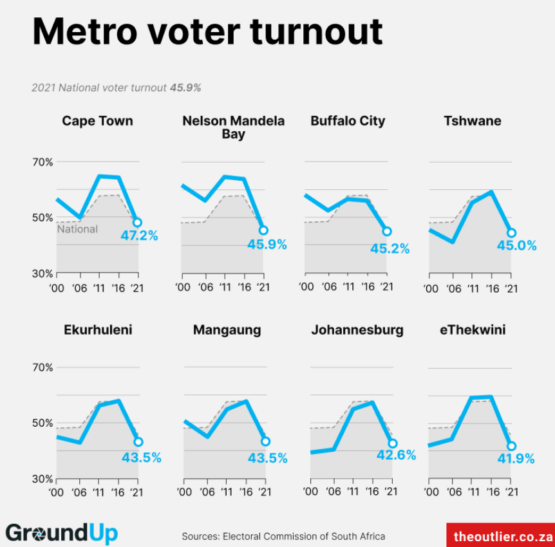
On 1 November 2021, around 12 million individuals cast their votes for municipal leaders, which represents approximately 46% of those registered to vote. This turnout marked the lowest participation in local elections since the establishment of democracy.
In many metropolitan municipalities, an even smaller percentage of registered voters participated in the 2021 elections.
Cape Town recorded the highest turnout among metros at nearly 47%, just above the national average. Nelson Mandela Bay also reached the national turnout level of about 46%.
On the other hand, eThekwini experienced the lowest turnout at about 42%, followed by Johannesburg (around 43%), Ekurhuleni and Mangaung (both around 44%), Tshwane (45%), and Buffalo City (46%).
Every metropolitan municipality saw a marked decrease in turnout compared to the previous two local government elections. For instance, voter participation in Cape Town was around 64% in both 2011 and 2016.
ADVERTISEMENT
CONTINUE READING BELOW
Read: DA majority in Joburg within reach, but hinges on voter turnout
A survey of metro voters indicated that practical barriers, rather than a lack of interest in voting, were the main reasons for lower turnout. Conversely, a different study focusing on national voters identified political disillusionment as the primary cause for their absence from the polls. 
A decade prior to the decline in voter turnout in 2021, the trend was quite the opposite.
In the 2011 local government elections, the national turnout was close to 58%, a significant increase from around 48% in both 2000 and 2006.
While turnout was quite low in many metros in 2006, it surged in 2011. Researchers have proposed various explanations, including vigorous campaigning by opposition parties and heightened service delivery protests in metropolitan areas: individuals involved in these protests may have been more motivated to vote to attract government attention.
With elections scheduled for 4 November, the potential for recovery in metro turnout remains uncertain. South Africa’s most extensive pre-election survey, conducted by News24 and SABI, estimated a 52% turnout in its projections.
The second largest poll, executed by Ipsos, involved 3,600 participants across the nation in June and July, revealing that around three-quarters of those registered expressed a high likelihood of voting.
ADVERTISEMENT:
CONTINUE READING BELOW
Ten weeks prior to the 2021 elections, 71% of registered voters surveyed by Ipsos indicated their intention to vote. However, a week ahead of the election, Ipsos predicted that only 56% of registered voters would actually participate. Ultimately, the turnout ended up being 46%.
Read: SA’s local elections: new entrants likely to be the big winners
External factors, such as the weather on election day, also play a significant role.
Chart produced by The Outlier in collaboration with GroundUp.
© 2026 GroundUp. This article was originally published here.