

6 Top Stablecoin Yields for 2026: Ranking Ways to Earn with USDT and USDC Based on Funding Sources
Every stablecoin yield offering grapples with the same challenging inquiry. Your USDC is not intended to grow in value; its design prevents appreciation. Therefore, when a platform advertises returns of 4%, 8%, or even 20% on a dollar-pegged token, you should recognize that this money originates from a specific source — and understanding that source is crucial.
Typically, comparison articles rank these offers by their listed APY, which is fundamentally misguided. A 12% yield that relies on a sustainable market mechanism is vastly different from a 12% yield that depends on token emissions that will cease in six months.
This ranking, however, proposes a different approach: six avenues to generate yield on stablecoins, organized by the resilience of the underlying sources.
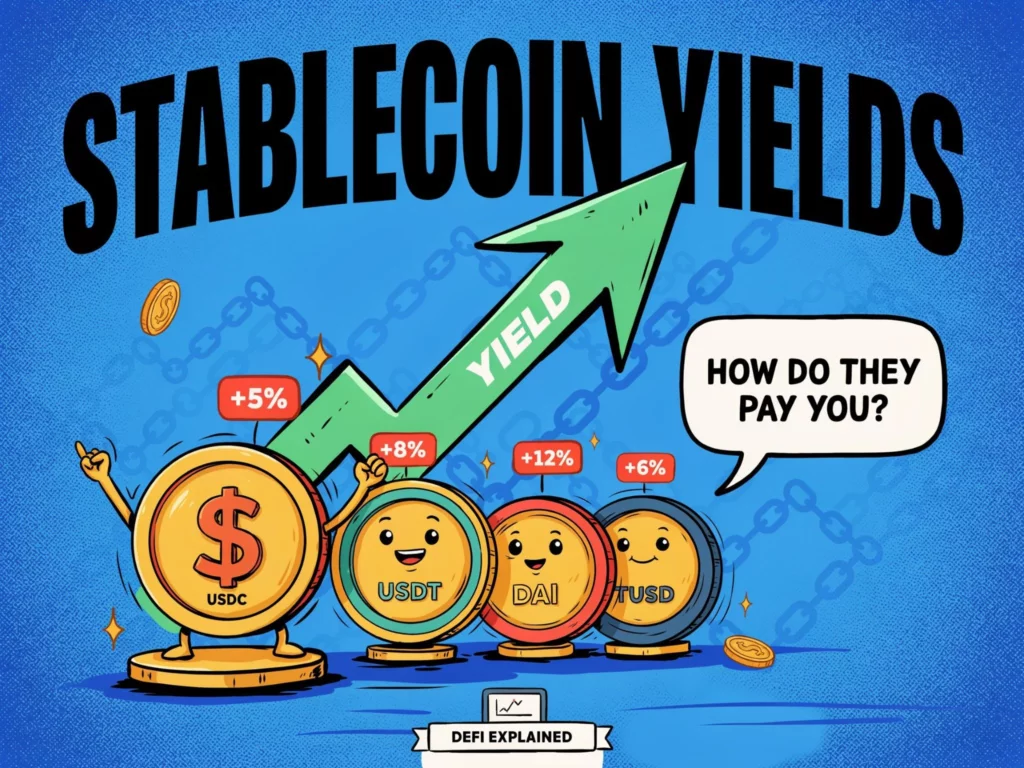
The essential question to ask before depositing
Inquire about how the counterparty utilizes your funds to generate returns. The honest answers are limited to a few options:
- They lend the funds to someone who pays interest.
- They invest in Treasuries and distribute the coupon.
- They implement a trading strategy that yields returns.
- They compensate you from token emissions or a marketing budget.
The first three represent genuine businesses, while the fourth signifies an imminent expiration. If a platform can’t distill the answer down to a sentence, that’s your answer.
1. Funding-rate arbitrage — yield from a market mechanism
The source: perpetual futures contracts facilitate funding payments between long and short holders every few hours to align the contract price with spot prices. Crypto traders generally maintain long positions, which means shorts often benefit. According to BitMEX’s Q3 2025 analysis, funding was positive for over 92% of the quarter — a persistent trend and not a one-off event.
A position that holds spot while shorting the perpetual futures captures that funding as the two components offset each other’s directional bias. The yield does not derive from a token emission or a borrower who might default; it originates from leveraged traders who pay to keep their positions active.
Typical return: may fluctuate based on funding conditions and strategy. VectorTraders provides target ranges from 7.8% to 43.3% annualized through its various plans, depending on duration and strategy mix.
The catch: funding rates can turn negative for lengthy periods, reversing the payment dynamic. Execution happens on third-party exchanges, so there’s inherent venue risk. Managing it personally means consistently overseeing two legs across platforms — hence, many opt for managed products instead of the direct approach. The complete mechanism is detailed here, with a worked example included.
Why it ranks first: the source is structural, not promotional. Perpetual futures are a mainstay — on-chain perp DEXs alone drove $593 billion in turnover over 30 days as of September 2026 — and as long as traders use leverage, funding will be paid.
Start small to observe performance. VectorTraders’ entry plan starts at $100 for a seven-day term, making it an affordable way to witness funding capture in action. Explore current plans →
2. Tokenized Treasuries — yield from government debt
The source: your stablecoins acquire short-dated US Treasury bills through a tokenized fund, allowing you to earn the coupon.
Typical return: mirrors short-term Treasury rates, adjusted for a management fee. Essentially, you receive what T-bills pay.
The catch: returns are constrained at the risk-free rate and taper off when rates fall. Many of these offerings are exclusive to accredited or institutional investors, and redemption processes may require a business day or longer.
Why it ranks second: it is the most straightforward source on this list, and that’s a compliment. You are fully aware of where your funds are coming from.
3. DeFi lending — yield from borrowers
The source: platforms like Aave and Morpho enable you to lend stablecoins to a pool from which borrowers can draw, earning interest in the process. Rates fluctuate according to utilization.
Typical return: typically low single digits during quiet market conditions, with spikes occurring when leverage demand is elevated. Highly variable.
The catch: the immediate risk is from smart contracts. The subtler risk is that rates may collapse just when you need them most; during calm markets, borrowing activity diminishes. There is also exposure to the protocol’s liquidation mechanics performing correctly during downturns, which is precisely when it faces the most pressure.
4. Exchange rewards programs — yield from revenue sharing
The source: exchanges provide rewards on stablecoin holdings, generally funded by sharing the interest earned from their reserves.
Typical return: usually low single digits; for instance, Coinbase’s USDC rewards have hovered around 3.5%.
The catch: this category has drawn attention from regulators. The GENIUS Act, enacted in July 2025, prohibits stablecoin issuers from directly paying yield on reserves. The CLARITY Act, which sought to extend these restrictions to platforms, was narrowly defeated in a Senate procedural vote on September 2026, thus preventing the platform-specific ban from taking effect. An unresolved proposed OCC rule concerning affiliate arrangements remains pending.
In essence, this yield source exists at the discretion of a regulatory process that is still evolving. It’s acceptable for short-term cash storage but not suitable for long-term planning.
5. Yield-bearing stablecoins — yield built into the token
The source: the token itself generates value, typically derived from Treasuries or a delta-neutral strategy implemented by the issuer.
Typical return: varies significantly by product, as “yield-bearing stablecoin” refers to a mechanism rather than a specific risk profile.
The catch: you simultaneously assume the issuer’s strategy risk and their peg risk, which are closely linked — if the strategy falters, the peg is also likely to fail. Investigate what truly backs the token; some may be Treasury wrappers, while others come with leveraged positions cloaked in an enticing dollar sign.
6. Liquidity provision and yield farming — yield from emissions
The source: you allocate stablecoins to a liquidity pool, earning trading fees in addition to token rewards.
Typical return: advertised yields are often the highest listed here, but realized returns frequently fall short.
The catch: headline APYs for stablecoin farms are usually driven by token emissions more than by trading fees. Emissions diminish over time, token prices often decline as rewards are liquidated, and the cited APY assumes both scenarios don’t occur. Additionally, there’s the risk of impermanent loss with non-pegged pairs and the ever-present smart contract risk.
Why it ranks last: not because it never succeeds — it can yield significant results — but simply because its source relies on a marketing budget that has an expiration date.
Side by Side Comparison
| Method | Yield Source | Durability | Main Risk |
| Funding-rate arbitrage | Payments from leveraged traders | Structural | Negative funding periods, venue risk |
| Tokenized Treasuries | Government debt coupon payments | Very high | Rate dependency, access limitations |
| DeFi lending | Borrower interest | Moderate | Smart contract, rate drop |
| Exchange rewards | Revenue sharing from issuer reserves | Uncertain | Regulatory |
| Yield-bearing stablecoins | Varies by issuer | Varies | Combined strategy and peg risks |
| Liquidity provision | Trading fees + token emissions | Low | Emission decay, impermanent loss |
How to Make Your Choice
If you desire the yield to be intact in two years, prioritize durability over headline rates. Both tokenized Treasuries and funding-rate strategies possess independent sources that exist beyond anyone’s marketing initiatives.
If you’re simply parking cash for a few weeks, exchange rewards offer a no-fuss option, and the regulatory situation won’t be resolved during your holding period; just avoid planning your finances around it.
If your goal is to achieve the highest sustainable rate, funding-rate arbitrage has historically provided more than Treasuries as it rewards you for genuine operational effort—managing two legs across platforms, handling exchange risks, and navigating periods when funding rates flip. This is a genuine source of return, not an effortless gain, and comes with real risks.
If you’re tempted by a 20%+ farm APY, assess what proportion consists of fees and what portion results from token emissions before making any deposits; what you uncover is often less than comforting.
One rule governs them all: if you can’t articulate the origin of the money, you’re not earning yield; instead, you’re the one providing it.
Interested in the funding-rate strategy without managing it on your own? Plans begin at $100 with a seven-day term. Check out VectorTraders →
Frequently Asked Questions
What is the best stablecoin yield in 2026?
It depends on your optimization goals. Tokenized Treasuries boast the most predictable yield source. Funding-rate arbitrage strategies have historically yielded higher returns, albeit with operational and market risks. Headline APYs on farms are often the highest, but they lack durability.
Is stablecoin yield legal in the US?
The GENIUS Act prohibits stablecoin issuers from directly offering yield on reserves. The CLARITY Act attempted to extend similar restrictions to platforms but failed during a Senate procedural vote in September 2026. Regulations in this area are evolving, so verify the current terms with any provider.
Why do stablecoins offer yield if they don’t appreciate?
They do not generate yield independently. The yield is derived from what the platform chooses to do with the deposit — whether lending, purchasing Treasuries, or executing a trading strategy. The stablecoin is simply the unit of account for deposits and withdrawals.
What’s the safest approach for earning on stablecoins?
No options presented are devoid of risk. Tokenized Treasuries present the least strategy risk as they are backed by government debt. All other methods introduce additional counterparty, smart contract, or market risks.
How much can you generate from USDT or USDC?
Low single digits can be achieved through exchange rewards and Treasury-related products. Returns from DeFi lending are variable. Higher yields are attainable from strategy-focused products, with VectorTraders reporting target ranges from 7.8% to 43.3% annualized based on plan and term; however, returns can fluctuate according to market conditions.
Can funding rates be negative?
Yes. In times of market alignment towards short positions, long holders receive payments. BitMEX reports that funding was positive for more than 92% of Q3 2025, although negative periods can last for weeks during drawdowns, such as those experienced in March 2020 and following the FTX collapse in November 2022.
Disclosure: This content is provided by a third party. Neither crypto.news nor the article’s author endorses any products mentioned in this piece. Users should conduct their own research before taking any actions concerning the company.