

Grayscale Reports US Cryptocurrency Engagement Between 15% and 20% Before Midterm Elections
According to Grayscale’s analysis, the United States represents roughly 15–20% of the global cryptocurrency landscape, suggesting that the rate of adoption will continue irrespective of the outcomes of the upcoming midterm elections.
Summary
- Grayscale estimates that the US accounts for 36% of Bitcoin’s hashrate and 31% of Ethereum full nodes.
- United States shares in trading, payments, and wallet usage are notably lower compared to those in mining and network infrastructure.
- The estimates are derived from 14 different indicators that vary in their reporting timelines and geographical focus.
- Research from Cambridge provides an alternate perspective, emphasizing the notable US participation reflected in their survey.
The findings in Grayscale’s report, which was published on Oct. 28 by research lead Zach Pandl, highlight that the advancement of cryptocurrency is beyond the influence of US politics. The report features a chart that compiles metrics related to user engagement, ownership, transactions, and infrastructure.
Grayscale highlights significant US contributions to Bitcoin and Ethereum infrastructure
The chart indicates that Bitcoin mining is predominant, with the US estimated at 36% of the global hashrate. Following closely are Ethereum full nodes at 31%, while the US share of on-chain transaction values is projected at 26%.
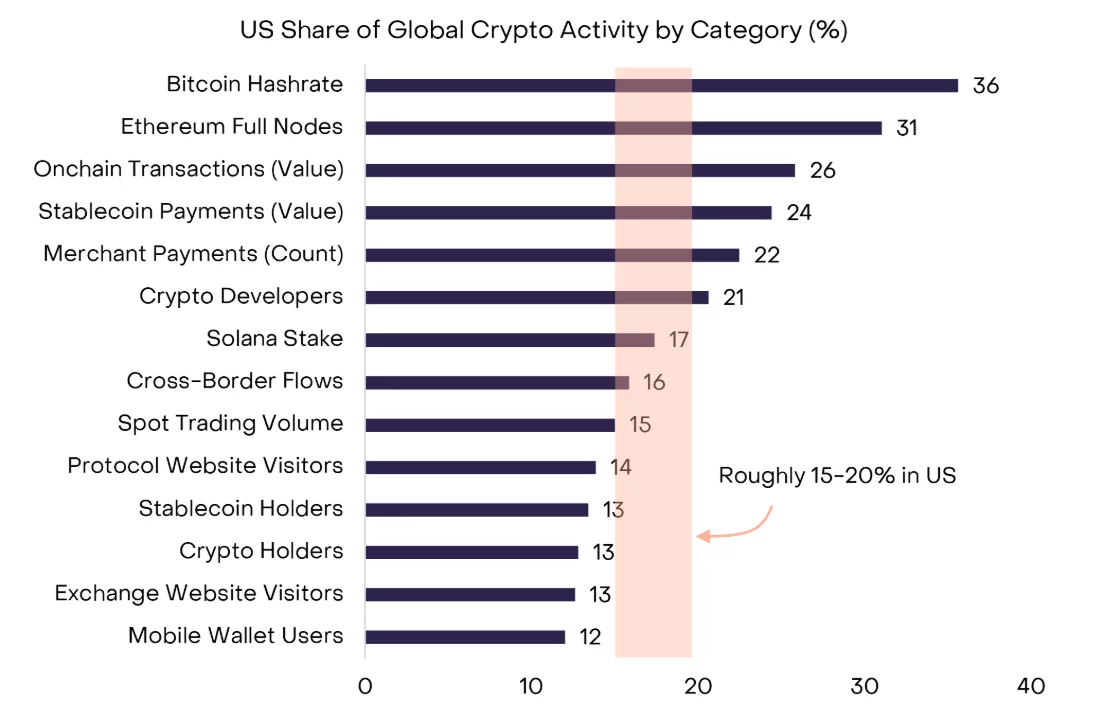
In contrast, figures related to payment activities are lower than those related to infrastructure. The chart assigns 24% of stablecoin payment values and 22% of merchant payment transactions to the US, with developers accounting for 21%.
Lower in the rankings, Solana staking makes up 17%, cross-border flows at 16%, and spot trading volume at 15%. Meanwhile, protocol website traffic constitutes 14%.
The lowest estimates pertain to ownership and access, with crypto holders, stablecoin holders, and exchange website visitors each at 13%, and mobile wallet users at 12%, as per the chart.
Across all categories displayed, US shares range from 12% to 36%, indicating a disparity of 24 percentage points. The US Bitcoin hashrate is three times greater than that of mobile wallet usage, based on the rounded figures in the chart.
The 15–20% estimate encompasses various metrics
The footnote in the chart explains Grayscale’s methodology for deriving this headline figure. The indicators yield a median US share of 16% and a mean of 19%, which the firm utilizes to substantiate the approximate range of 15–20%.
The observations span the years 2023 to 2026, depending on the metric, and were collected up to October 2026. Not every measure shares an identical reporting timeline.
Moreover, geographical coverage differs. Estimates for crypto holders and stablecoin payments refer to North America, but the stablecoin-holder figure is particular to Phantom Wallet. Merchant payment figures are solely based on data from CoinGate.
Among the sources referenced are a16z, Forbes, Triple-A, Phantom, Kaiko, the Bank for International Settlements, Solana, Electric Capital, CoinGate, McKinsey/Artemis, Chainalysis, TRM Labs, the University of Cambridge, and Hashrate Index.
Thus, Grayscale presents this range as an approximation derived from numerous indicators. The chart encompasses transaction values, payment counts, ownership estimates, and infrastructure metrics, each with a specified scope.
Cambridge’s mining research evaluates a different sample
A separate report from Cambridge, published in 2025, indicated that 75.4% of the surveyed mining activities took place in the US, with 7.1% in Canada.
This survey included 49 mining companies operating across 23 different countries, accounting for approximately 48% of Bitcoin’s network hashrate during the data collection period.
Cambridge noted that the strong presence of American firms likely inflated the reported share for the US. The 75.4% figure pertains only to the activities captured in the survey and does not suggest that the US oversees that proportion of all Bitcoin mining.
Nevertheless, researchers recognized North America as the leading location for the activities surveyed, along with burgeoning operations in South America and the Middle East, as well as ongoing mining efforts in Northern Europe.
US crypto policy remains proactive ahead of the elections
Pandl’s analysis indicates that bipartisan ownership and institutional involvement are crucial to ongoing adoption. He cited polling data regarding cryptocurrency usage among both Republicans and Democrats, the bipartisan support for related legislation, and financial firms’ involvement with stablecoins, tokenized funds, and exchange-traded products.
Regulatory movements have persisted leading up to the elections. As previously covered by crypto.news, the OCC finalized regulations under the GENIUS Act on Oct. 21, addressing aspects like reserves, redemptions, risk management, and oversight, set to take effect on Jan. 18, 2027.
Additionally, the Federal Reserve unveiled separate proposals on Sept. 24, discussing reserve backing and applications from insured state member banks intending to issue stablecoins through their subsidiaries.
Legislation regarding market structure follows a different timeframe. Previous midterm coverage noted a 49-to-50 Senate vote on Sept. 15 against moving forward with debate on the CLARITY Act, which pertained to whether to begin consideration of the bill rather than its final approval.