

Unplugging from Urban Life and the Fuel Meter
South Africans have a reputation for holding high expectations regarding their vehicles. We aspire to enjoy the luxurious comfort of a high-end sedan, the practicality of a delivery truck, and the ruggedness of an off-road vehicle—all while minimizing stops at the fuel pump.
Could electrification be finally leading us to the perfect all-purpose vehicle?
This question emerged during a recent visit to China, where Jetour, a division of Chery Group, demonstrated how hybrid powertrains and cutting-edge technology are improving off-road vehicle capabilities. Drivers in South Africa might not have to wait too long to witness these advancements.
According to Jetour’s engineering team, the eagerly anticipated F700 pickup and G700 luxury SUV are scheduled to debut in South Africa in the third quarter of 2027.
Currently, both models are being modified for right-hand drive, and the local certification processes are still pending. Consequently, their final specifications tailored for South Africa remain undetermined.
More than just fuel efficiency
For many in South Africa, electrification is largely perceived through the prism of fuel efficiency. With fluctuating petrol prices and the necessity for long-distance travel, reducing fuel consumption has become increasingly vital. However, fully electric vehicles encounter challenges in remote regions where charging stations are scarce.
Plug-in hybrids offer a balanced solution by combining electric drive with a combustion engine, making long-distance drives less dependent on charging infrastructure. Jetour’s F700 and G700 take this concept further, harnessing electrification to enhance performance, comfort, and versatility.
The engineering team indicated that the current left-hand drive models produce a combined output of up to 665 kW and 1,135 Nm, supported by a 34.13 kWh battery, boasting a driving range that exceeds 1,000 km.
Yet, perhaps the most captivating feature is not merely the distance these vehicles can cover, but what they can achieve once they arrive.
During a private conversation inside the F700 in China, Jetour International President Ke Chuandeng referred to the vehicle’s battery as a source of power that extends beyond just propulsion.
“This isn’t just a vehicle; it’s a power station,” he remarked.
Powering the great outdoors
For South Africans traveling to remote campsites, farms, or locations with unstable power, this presents thrilling possibilities. Jetour Engineering affirmed that existing international models support vehicle-to-load (V2L) power discharge of up to 6.6 kW.
During the manufacturer’s Global Technology Experience Day, these vehicles showcased their capability by powering outdoor equipment directly. This technology can manage refrigeration units, lighting, cooking devices, and power tools, thereby reducing the need for separate generators.
The focus now shifts from whether the bakkie can transport you to the campsite to whether it can keep the coffee machine operational once you arrive. For some South Africans, that could be the more significant evaluation.
Ke also elucidated that the F700 can run its air conditioning without continuously operating the combustion engine, allowing passengers to enjoy comfortable rest overnight.
For farmers and contractors in remote areas, this external power can prove beneficial beyond just leisure.
However, the practicality of this feature depends on the battery charge available, the demand from appliances, and the energy reserves needed for driving. Still, a bakkie that can carry gear, alongside the capability to power that gear, offers a fundamentally different value proposition.

Jetour International President Ke Chuandeng. Image: Supplied
Could your vehicle become a power source?
Chery Group is exploring applications beyond basic appliance power. At its Global Innovation Conference in Wuhu, the manufacturer unveiled vehicle-to-grid technology alongside integrated solar, battery storage, and charging systems.
This vehicle-to-grid technology enables compatible vehicles to feed electricity back into an external network, allowing owners to charge during off-peak times and sell electricity when rates rise. Ke elaborated on this potential during our discussion, explaining how discrepancies between nighttime and daytime electricity prices can create opportunities in China.
For South Africa, where households and businesses are increasingly investing in solar energy and battery systems, this prospect is particularly enticing.
A vehicle may eventually serve as a valuable addition to home energy systems, providing backup electricity or participating in advanced energy management schemes.
Nevertheless, Jetour Engineering indicated that vehicle-to-home and vehicle-to-grid capabilities for South African models will depend on upcoming engineering and regulatory decisions. Thus, the current V2L capabilities should not be interpreted as a promise that local owners will soon be able to resell electricity back to the grid.
Making off-road adventures more accessible
Electrification is merely one facet of Chery Group’s broad technological aspirations. The Global Innovation Conference also showcased advancements in artificial intelligence, semiconductor technology, robotics, and smart mobility.
In a separate conversation, Ke explained that Jetour leverages Chery’s technological strengths while refining its own off-road capabilities, which include XWD intelligent four-wheel drive and GAIA all-terrain architecture.
Experienced off-roaders understand that managing traction, differential locks, power delivery, and momentum across varying surfaces is crucial. Jetour’s XWD system simplifies this process by providing selectable terrain modes and intelligent adaptation of the vehicle’s response.
Depending on configurations, the technology features front and rear differential locks, an electronically simulated central lock, and specialized modes such as Tank Turn, Crawl Mode, and Wading Mode.
While purists might argue that learning to select the correct differential lock is part of the adventure, many would prefer to let the vehicle handle the complexities while they concentrate on navigation.
GAIA synchronizes the hybrid powertrain, chassis, and suspension systems to create a harmonious blend of off-road performance and passenger comfort.
The goal is to make exploration less intimidating for novice drivers without compromising the capabilities that seasoned enthusiasts value. Technology may not substitute for good judgment, but it can substantially ease navigation through challenging terrains.
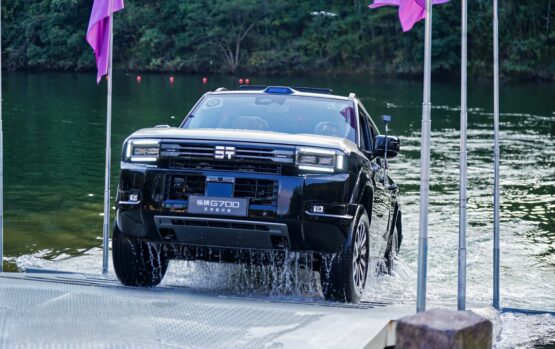
Jetour’s G700 luxury SUV. Image: Supplied
Beyond just driving
Jetour’s Travel+ philosophy carries this mindset into an extended realm beyond driving. The manufacturer has developed travel-centric accessories, including onboard refrigeration, rooftop camping gear, and flexible storage options.
Another exciting development is satellite communication. While in the F700, Ke highlighted the vehicle’s satellite communication system, which can provide connectivity outside conventional cellular networks.
For adventurers navigating through remote wilderness, being able to call for assistance without cellular service can offer significant peace of mind.
Jetour is also exploring drone integration as part of its travel ecosystem, which could allow travelers to scout unfamiliar landscapes from above. The availability of such features in South Africa will be subject to local regulations and product decisions.
The overarching message is that manufacturers are increasingly focusing on what drivers want to achieve at their destinations, rather than merely transporting them there.
What awaits South Africans
The Jetour Engineering team shared some revealing reference figures regarding their flagship vehicles and their current offerings in international markets:
|
Jetour F700 and G700 International Specifications |
|
| Specification | Current LHD Reference |
| Expected SA Introduction | Q3 2027 |
| Combined Power | Up to 665 kW |
| Combined Torque | Up to 1 135 Nm |
| Battery | 34.13 kWh LFP |
| Electric-Only Range | Approximately 100-110 km |
| Combined Range | Over 1 000 km |
| External Power Output | Up to 6.6 kW V2L |
| Wading Depth | 900 mm |
| Ground Clearance | F700: 220 mm; G700: 230 mm |
| Maximum Towing | F700: up to 3 500 kg; G700: up to 2 500 kg |
| F700 Payload | Up to 880 kg |
Source: Jetour Engineering, based on inquiries made for this article. Figures pertain to current left-hand-drive international variants and may differ by model or trim. Specifications for South African right-hand-drive models, including certified towing and payload ratings, are still under development.
The statistics appear promising, but potential buyers will still seek clarity on fuel efficiency, safety, reliability, after-sales service, and long-term ownership costs. These core issues remain vital, regardless of how advanced the technology might be.
Reimagining the all-rounder
It is refreshing to observe a manufacturer approaching electrification as an opportunity to enrich a vehicle’s utility instead of just reducing fuel consumption.
With the F700 and G700, Jetour illustrates how hybrid powertrains, smart driving technologies, and integrated energy storage can complement traditional off-road capabilities.
Perhaps the new standard for a modern adventure vehicle will not only depend on how far it can take you from civilization, but also on how much civilization it can bring along.
South African motorists can eagerly anticipate the upcoming 2027 launch.
The next generation of off-road vehicles may increasingly be evaluated based not just on their transportation capacity, distance traveled, or obstacles overcome, but on the opportunities they facilitate after arrival at their destination.
This piece is sponsored by Jetour.
Moneyweb does not endorse any products or services featured in sponsored articles on our platform.